
Sheridan County Water Supply Report
November Report
How to Use This Report
What is this report?
Instead of combing the internet and clicking a million links to learn about water supply in Sheridan County, let us do the work for you! This report compiles many trustworthy sources into an easy-to-read and access report. It includes information about streamflow, snowpack, drought, soil moisture, and precipitation for both the Tongue and Powder Rivers. This report is a one-stop shop for information that can help you be aware of water in Sheridan to make decisions for your ranch and your land.
Helpful Hints:
- All forecasts have the word forecast underlined in the page's title.
- Each page has a little blurb at the top that gives you some helpful information.
- If you would like to know more about a topic, check out the sources at the bottom of the page!
- Sources are precise and bring you as close as possible to the original source.
Table of Contents
Drought Index and Change
Drought History and Forecast
Precipitation - Tongue River
Precipitation - Powder River
Reservoir Capacity and Stream Flow
Select Stream Flow Stations
Tongue Water Supply Forecast
Powder Water Supply Forecast
Temperature and Precipitation
Temperature Forecast and Precipitation Forecast
Vegetation Drought Responses and Soil Moisture
Drought Index and Change
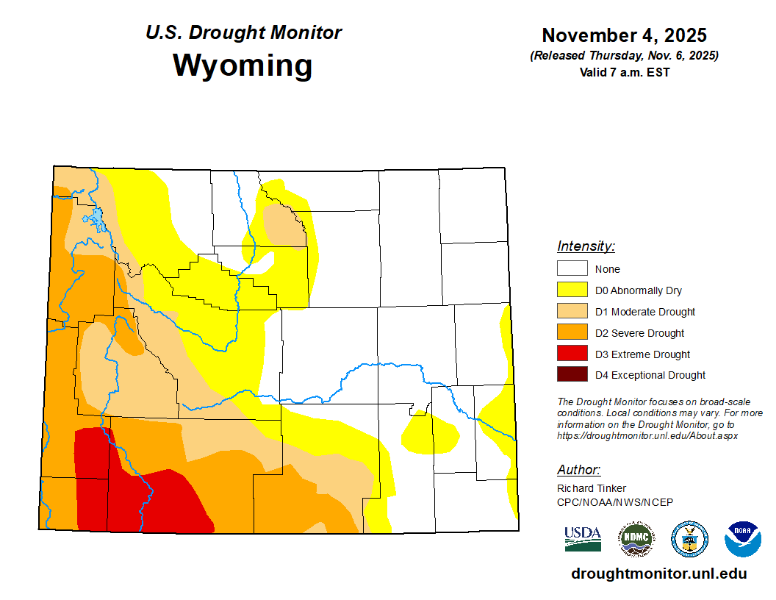
The U.S. Drought Monitor gives you a broad overview of the drought conditions in the US. Its strength is bringing together many ways of determining drought. It is useful as a large-scale view of drought, but local drought resiliency efforts are not considered.
Sheridan county has some abnormally dry conditions in the Big Horns, along the western edge of the county. More than half of Wyoming experiencing some level of drought, but it is reducing from last month.
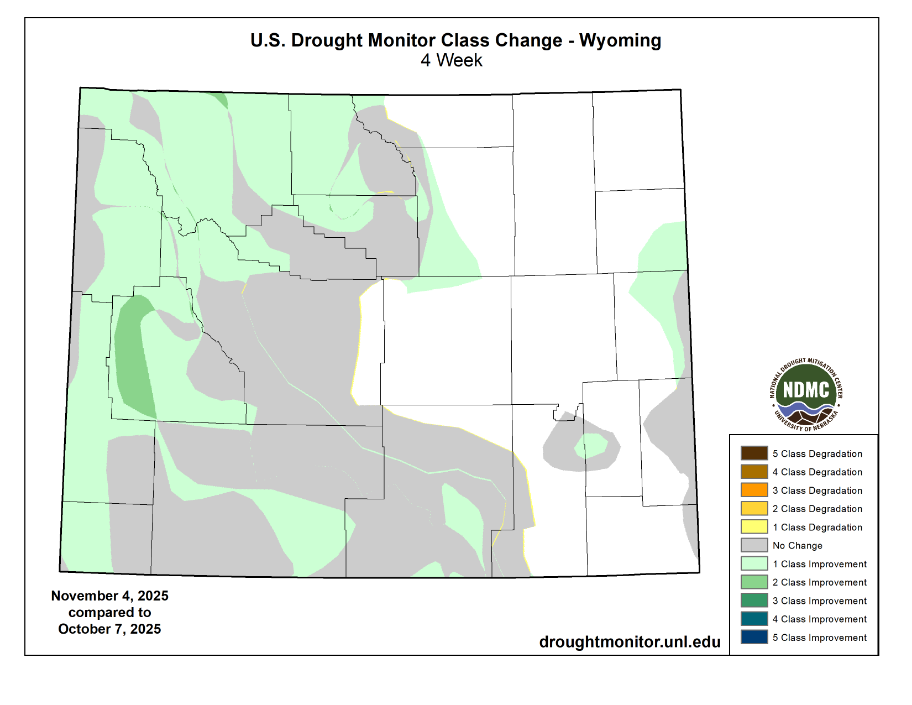
Sheridan county saw a Class 1 improvement along the western edge of the county. Much of the state is seeing improvement in drought conditions.
https://droughtmonitor.unl.edu/Maps/MapArchive.aspx
https://droughtmonitor.unl.edu/Maps/ChangeMaps.aspxhttps://droughtmonitor.unl.edu/Summary.aspx
Drought History and Forecast
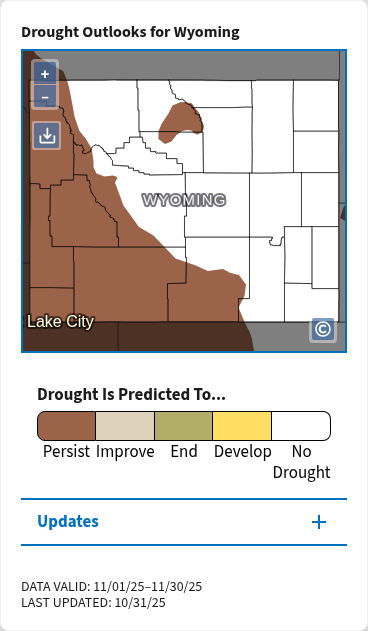
The first half of this page shows current conditions, followed by the forecast. The outlook is a prediction of
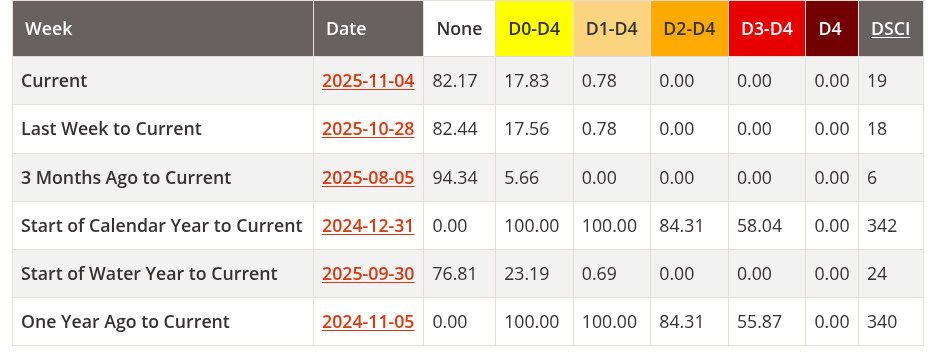
Drought conditions have degraded slightly. Three months ago 5.66% of the county was in dry conditions. Now 17.83% of the county is in dry conditions.
Looking into November, NOAA forecast shows that their will be no drought in Sheridan county.
https://droughtmonitor.unl.edu/CurrentMap/StateDroughtMonitor.aspx?fips_56033
https://www.drought.gov/forecasts
1https://www.cpc.ncep.noaa.gov/products/expert_assessment/mdo_summary.php
https://www.cpc.ncep.noaa.gov/products/expert_assessment/mdo_discussion.php
https://droughtmonitor.unl.edu/Summary.aspx
Precipitation - Tongue River
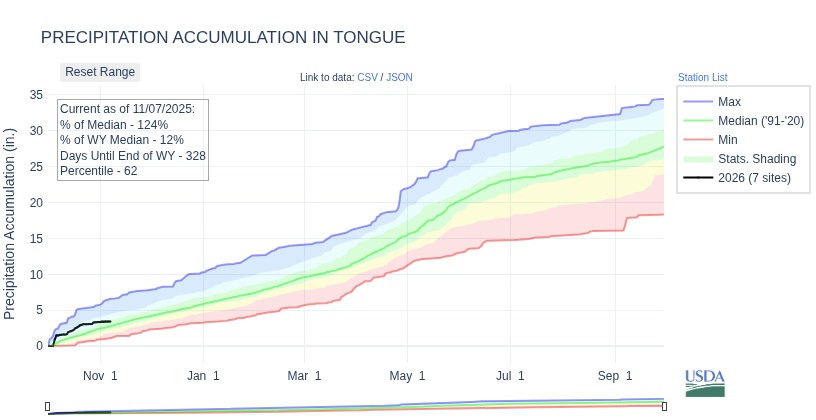
These graphs represent precipitation affecting the Tongue River. Snow water equivalent (SWE) represents the amount of water contained within the snowpack when it melts.
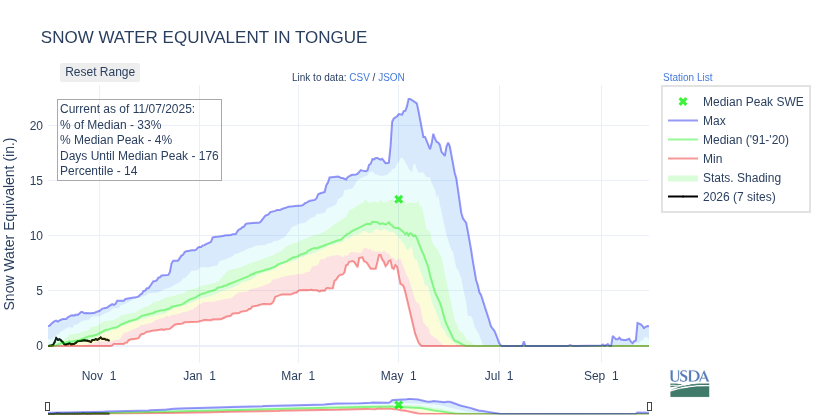
Snow Water Equivalent is at approximately 1. This is below normal for this time of year.
Precipitation accumulation is above normal for this time of year.
https://nwcc-apps.sc.egov.usda.gov/awdb/basin-plots/POR/WTEQ/assocHUCwy_8/tongue.html
https://nwcc-apps.sc.egov.usda.gov/awdb/basin-plots/POR/PREC/assocHUCwy_8/tongue.htm
Precipitation - Powder River
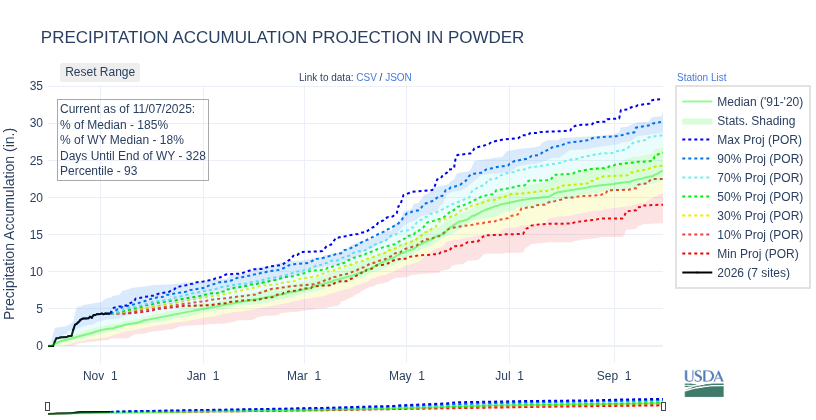
These graphs represent precipitation affecting the Powder River watershed. Snow water equivalent represents the amount of water contained within the snowpack when it melts.
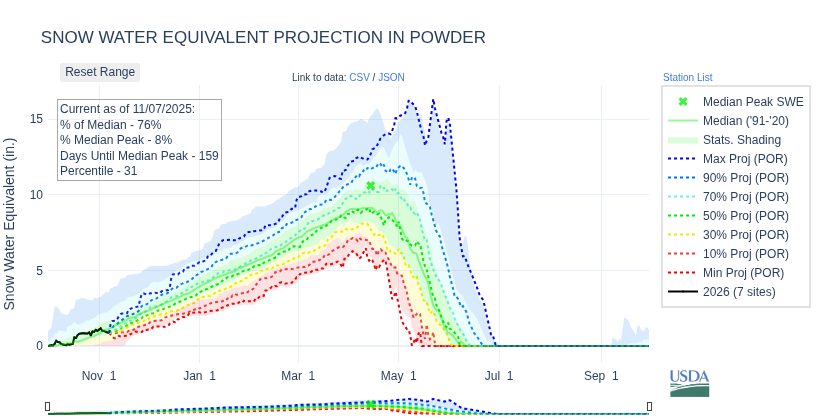
Snow Water Equivalent is approximately 1, which is normal for this time of year.
Precipitation accumulation is above normal for this time of year.
https://nwcc-apps.sc.egov.usda.gov/awdb/basin-plots/POR/WTEQ/assocHUCwy_8/powder.html
https://nwcc-apps.sc.egov.usda.gov/awdb/basin-plots/POR/PREC/assocHUCwy_8/powder.html
Reservoir Capacity and Stream Flow
The total capacity of reservoirs and current water storage includes inactive storage below the outlet.
Lake DeSmet
As of November 1, Lake DeSmet has a total of 198,983 acre-feet in storage. Capacity is 234,987.
| Reservoir | Total Storage (Acre-ft) | Current Storage (Acre-ft) | Percentage of Total Capacity (%) |
|---|---|---|---|
| Bighorn | 4,624 | 908 | |
| Cross Creek | 824 | 200 | |
| Dome Lake No. 1 | 1,506 | 1,117 | |
| Kearney Lake | 6,324 | 2,555 | |
| Park Lake | 10,362 | 4,551 | |
| Sawmill | 1,275 | 683 |
Tongue River Reservoir
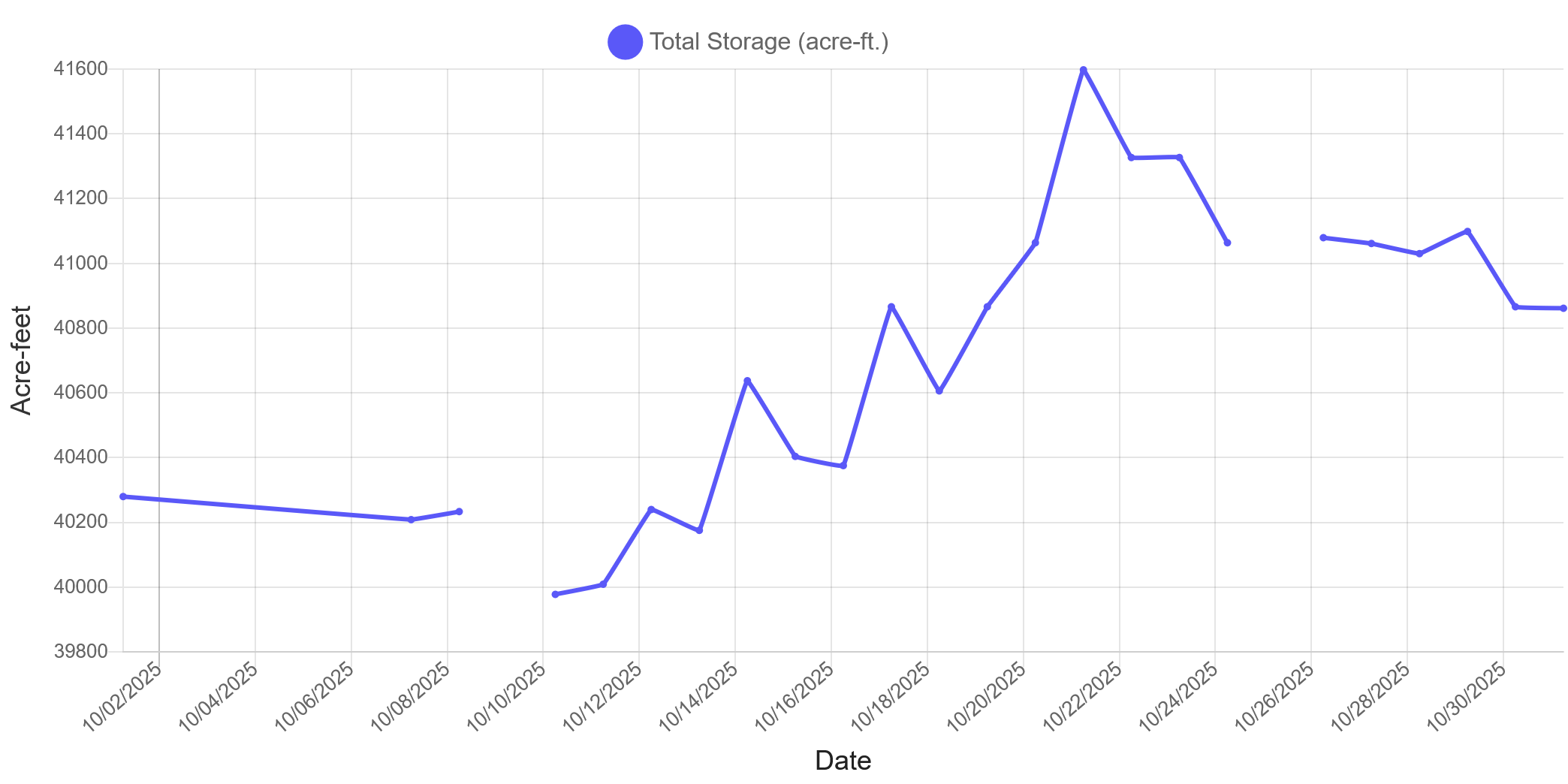
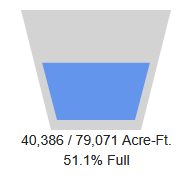
Water levels have remained the same since October, to 40,386 acre-feet. The reservoir is 51.1% full.
Reservoir Level
This graph displays the real time data of the Tongue River Reservoir. This data remains provisional until it is officially reviewed due to variables that can affect the gages. These include but are not limited to algal and aquatic growth, sediment movement, malfunction of recording equipment, and back water from ice or debris such as log jams.
Sources:Lake DeSmet Operating Department at lakedesmet@johnsoncowy.us
https://seoflow.wyo.gov/Data/Map/Parameter/Total%20Storage/Location/Identifier/Interval/Latest
https://gis.dnrc.mt.gov/apps/stage/gage-report/location/3f087fe86bde421f857dfedff4e40e93/1680476400000-1683154740000
Select Stream Flow Stations
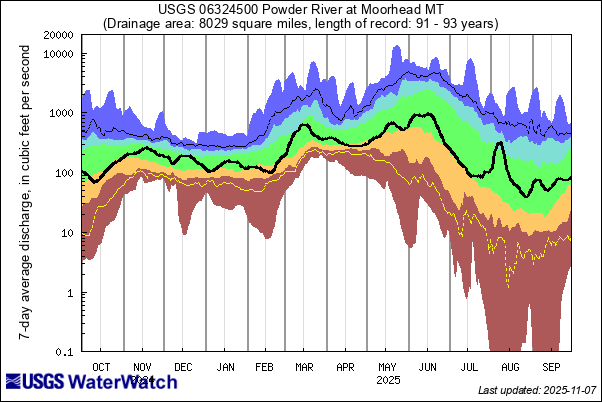
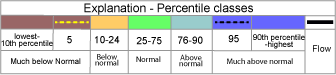
These graphs give context to stream flow percentile classes. The selected USGS stream gauges are on the stateline with Montana, being the downstream end of the Tongue and Powder within our region. The flow represent average 7-day flows. The vertical axis is logarithmic meaning it goes up by 10x for each major tick mark.
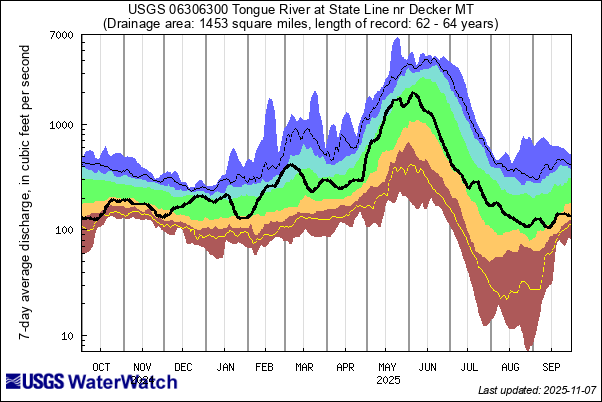
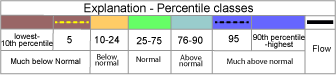
Streamflow is in the middle portion of the "Below Normal" range or 10-24th percentile.
Streamflow is in the lower portion of the "Normal" range or 25-75th percentile.
https://waterwatch.usgs.gov/index.php?id=mv01d
https://waterwatch.usgs.gov/?id=wwchart_sitedur&ofmt=plot_mvbg&site_no=06306300
https://waterwatch.usgs.gov/?id=wwchart_sitedur&ofmt=plot_mvbg&site_no=06324500
Temperature and Precipitation
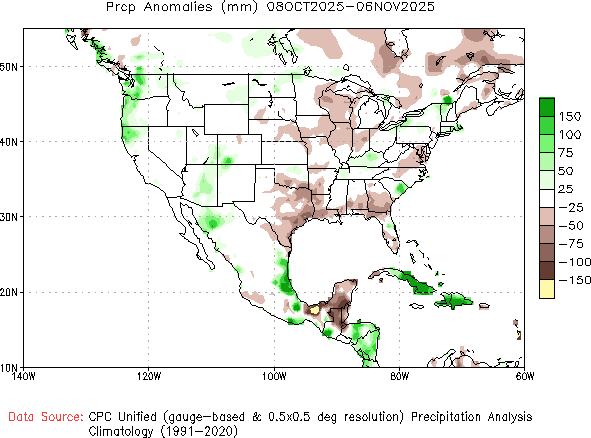
Temperature and precipitation are large drivers of changes in drought conditions. As you might expect, high temperatures and low precipitation can worsen drought conditions while low temperature and high precipitations can improve them.
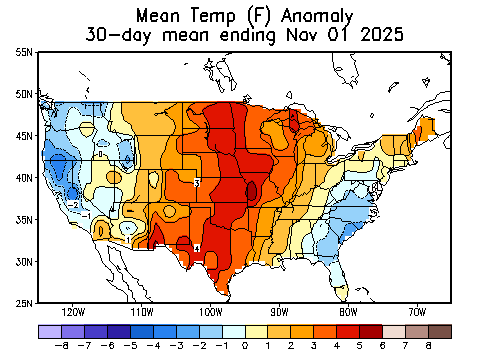
October was 1 to 2 degrees warmer in Sheridan county than most years.
The precipitation anomaly for Sheridan County was normal in October.
https://www.cpc.ncep.noaa.gov/products/tanal/temp_analyses.php
https://www.cpc.ncep.noaa.gov/products/Global_Monsoons/American_Monsoons/NAMS_precip_monitoring.shtml2
https://www.cpc.ncep.noaa.gov/products/expert_assessment/mdo_discussion.php3
https://www.weather.gov/byz/daily_records?city=Sheridan
Temperature Forecast and Precipitation Forecast
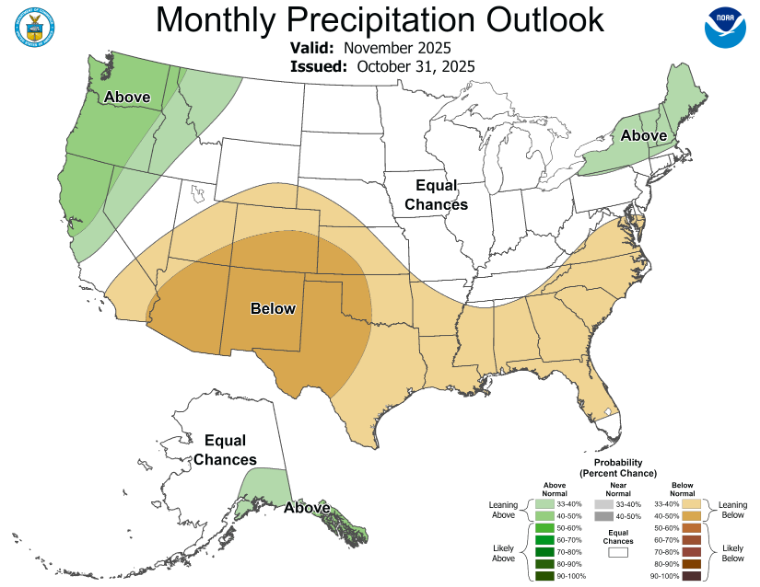
https://www.cpc.ncep.noaa.gov/products/predictions/long_range/lead14/interactive/index.php Explore link above for an Interactive map that displays percentage chance above and below normal for any point in US
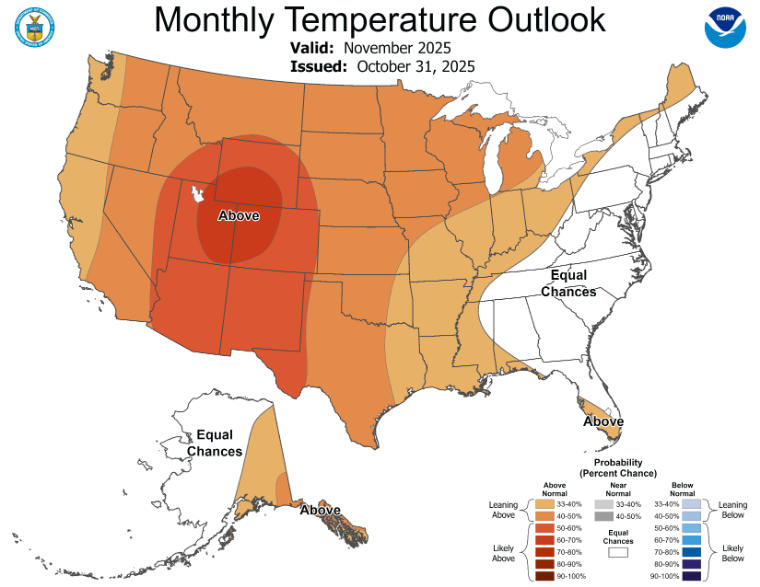
Sheridan county has a "likely above" probability to have higher temperatures in November than normal.
Sheridan has an equal chances outlook for precipitation in October.
https://www.cpc.ncep.noaa.gov/
https://www.cpc.ncep.noaa.gov/products/predictions/long_range/lead14/interactive/index.php –Interactive with percentages
https://www.cpc.ncep.noaa.gov/products/expert_assessment/mdo_discussion.php
Vegetation Drought Responses and Soil Moisture
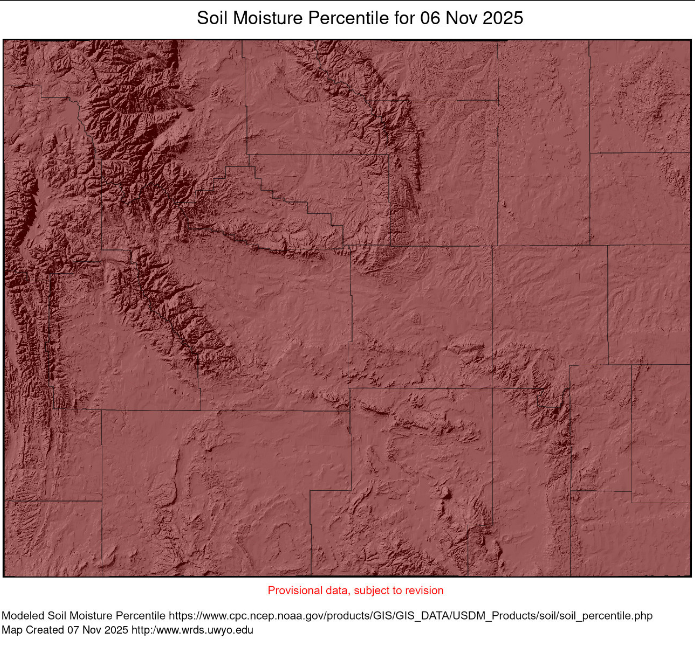
The graphs below are two ways of visualizing on-ground conditions. The vegetation Drought Response Index (Vegdri) uses a satellite to estimate vegetative stress. Soil moisture is helpful when looking at many things. Soil acts as a bank for moisture and can buffer drought degradation or improvement. It is also the water that plants have available to them so is linked to vegetative stress.
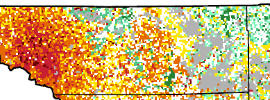
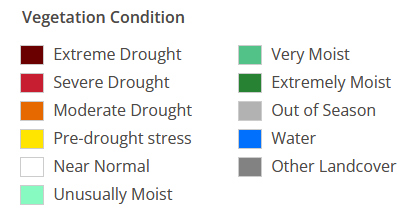
Vegetation Drought Response is sporadic across the county showing signs of both pre drought stress and high levels of moisture.
Soil moisture percentile fall in the 0-2% across the county.
https://vegdri.unl.edu/Home/VegDRIQuad.aspx?WY,2
https://www.cpc.ncep.noaa.gov/products/Soilmst_Monitoring/US/Soilmst/Soilmst.shtml
http://www.wrds.uwyo.edu/Soil/SM-Ptile-Current.html
Additional Resources
These are the broad sources we got information from. These websites are trustworthy and are reliable sources for additional information. In the future we hope to add more source for additional information.
- https://droughtmonitor.unl.edu
- https://www.drought.gov
- https://www.cpc.ncep.noaa.gov
- https://www.nrcs.usda.gov/wps/portal/wcc/home
- https://waterwatch.usgs.gov
- Lake DeSmet Operating Department at lakedesmet@johnsoncowy.us
- http://dnrc.mt.gov/divisions/water/projects/tongue-river
- https://seoflow.wyo.gov/Data/Map/Parameter/Total%20Storage/Location/Identifier/Interval/Latest
- https://vegdri.unl.edu/Home/VegDRIQuad.aspx?WY,2